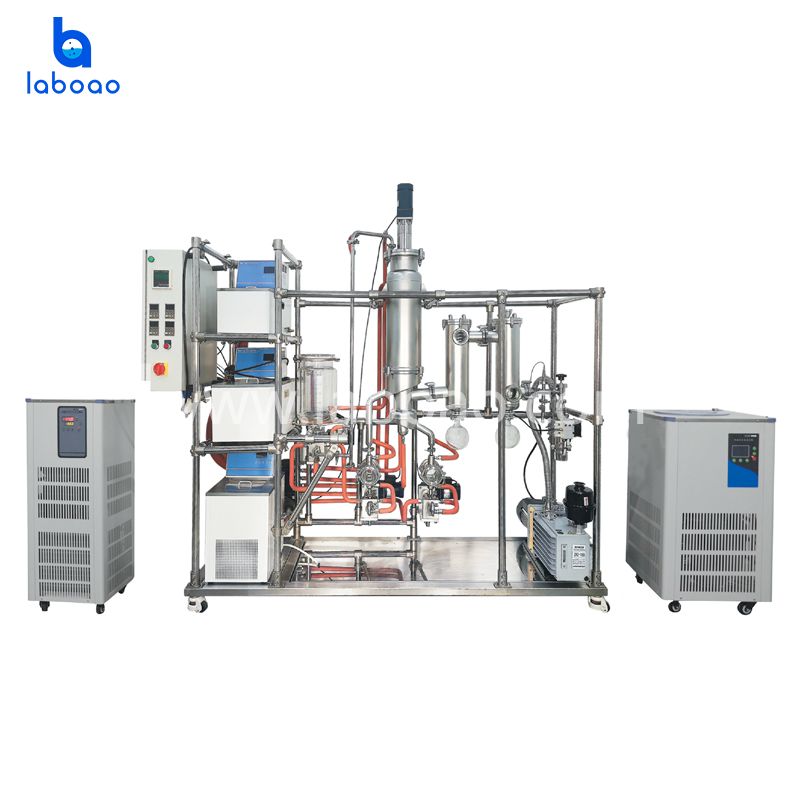
In high-end sectors such as fine chemicals, biopharmaceuticals, and natural product extraction, high purity and high yield are the ultimate goals. Traditional distillation methods are limited by boiling points; high temperatures can compromise the stability of components, and yields are often low—making them increasingly unable to meet the rigorous standards required for high-value-added products. Molecular distillation (short-path distillation), however, breaks through these traditional technical barriers with its core advantages: low temperature, high vacuum, short residence time, and high precision. It achieves both high purity and high yield, earning recognition across the industry as a "purification powerhouse."
I. Moving Beyond Boiling Point Dependence: Precision Separation at the Molecular Level
The core principle of molecular distillation relies on molecular mean free paths rather than boiling points, enabling molecular-level sorting within a high-vacuum environment.
1. High-Vacuum Environment: Operating at pressures as low as 0.001 mbar significantly lowers the material's boiling point, eliminating the high-temperature limitations associated with traditional distillation.
2. Differences in Molecular Mean Free Path: Light molecules (target products) have a long mean free path, allowing them to travel directly to the condenser surface for collection; heavy molecules (impurities) have a short mean free path and return to the liquid phase after collision, ensuring efficient separation.
3. Ultra-Short Path Design: The minimal distance between the evaporation surface and the condensation surface allows molecules to travel without obstruction, maximizing separation efficiency. Simply put: it precisely "sifts out" the target substance without boiling, high heat, or component degradation—making it perfectly suited for materials that are high-boiling, heat-sensitive, or prone to oxidation.
II. Four Core Advantages: Delivering Both High Purity and High Yield
1. Low-Temperature Distillation: "Zero Damage" to Active Ingredients
Operations are conducted at low temperatures (40–60°C)—50–100°C lower than traditional processes—preventing thermal degradation of heat-sensitive components and preserving natural ingredients intact.
2. High-yield purification with "zero waste" of raw materials
Leveraging separation based on molecular properties to overcome azeotropic separation challenges, this process boosts product yields by 10%–30% and achieves purity levels exceeding 99%.
3. Short residence time with "zero quality degradation"
With a wiper speed of 50–300 rpm, an ultra-thin dynamic liquid film is formed; the short material residence time prevents coking and discoloration, ensuring consistent product quality.
4. Physical separation ensuring "zero residue"
A purely physical separation process requiring no solvents or chemical reactions, fully compliant with rigorous safety standards in the food and pharmaceutical industries.
III. Versatile, high-performance solution for diverse sectors
1. Pharmaceuticals and cosmetics
Purifies active pharmaceutical ingredients to ensure consistent potency and purity; refines skincare ingredients, making it a preferred choice for high-end cosmetics.
2. Food and health supplements
Refines fish and algal oils to increase the concentration of active ingredients; purifies essential oils while preserving their aroma and bioactivity.
3. Fine chemicals and new materials
Capable of purifying high-boiling-point materials and polymer monomers, thereby optimizing overall product performance.
IV. High purity and yield: Cost reduction and efficiency gains
Traditional distillation: High temperatures cause degradation, resulting in low yields, insufficient purity, and potential residues. Molecular distillation: Low-temperature processing preserves ingredient stability; high-vacuum conditions ensure purity; short residence times maintain quality; and high yields reduce costs. It achieves high purity and high yield in a single step, significantly enhancing product value and market competitiveness.
V. Conclusion
From laboratory settings to industrial-scale production, molecular distillation has become the standard technology for purifying high-value products due to its exceptional versatility. Delivering both high purity and high yield through gentle, non-damaging separation, it empowers enterprises—whether dealing with natural products, pharmaceutical ingredients, or fine chemicals—to overcome technical bottlenecks and manufacture premium, high-value products.