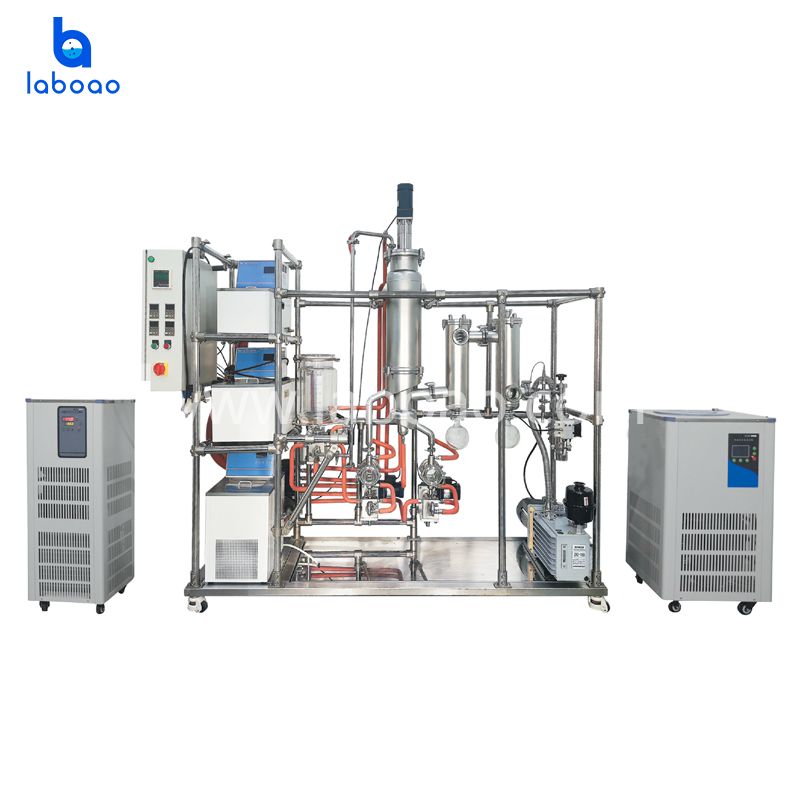
As a core piece of equipment for the purification of heat-sensitive, high-value-added materials, the stable operation of a molecular distillation system directly determines the yield and quality of the final product. The most frequent operational issues include unstable vacuum levels, uneven liquid film distribution, and the presence of impurities in the distillate. Many users find themselves unsure of how to address these problems; therefore, this guide outlines a comprehensive troubleshooting approach and provides practical solutions.
I. Issue 1: Unstable Vacuum (Fluctuating Levels)
Common Causes:
1. System leaks: Issues with flanges, gaskets, sight glasses, dynamic seals at discharge points, or loose fasteners.
2. Presence of light components, moisture, or low-boiling-point solvents in the feed material, leading to continuous outgassing that exceeds the capacity of the vacuum system.
3. Vacuum system malfunctions: Degraded pump oil, abnormal heating in the diffusion pump, insufficient pumping speed of the backing pump, or liquid accumulation in the piping.
4. Poor cooling efficiency at the condensation surface: Condensable gases fail to condense promptly, placing an ongoing, excessive load on the vacuum system.
Solutions:
1. Shut down the system to perform a pressure-hold leak test. Focus on all sealing components; replace any aged PTFE or fluoroelastomer (FKM) gaskets.
2. Pre-treat the feed material: Ensure thorough drying, solvent removal, and degassing to minimize outgassing during the distillation process.
3. Regularly replace vacuum pump oil and verify the heating power of the diffusion pump. For materials with high viscosity or high outgassing rates, consider upgrading to a multi-stage vacuum system.
4. Monitor the temperature and flow rate of the cooling medium to ensure sufficient heat exchange in the condenser, allowing for the efficient capture of condensable components.
5. Note: A stable vacuum is the foundation of molecular distillation. Fluctuations in vacuum levels directly alter the mean free path of the molecules, which can significantly degrade separation performance. II. Fault 2: Uneven liquid film thickness, film rupture, and localized material accumulation or coking
Common Causes
1. Issues with the film-scraping mechanism: Worn scraper blades, insufficient elasticity, inappropriate rotor speed, or inadequate torque (frequently occurs with high-viscosity materials).
2. Feed irregularities: Fluctuating feed flow rates, excessively low feed temperature, or high material viscosity resulting in poor flowability.
3. Impurities or residual scale on the inner wall of the heating cylinder, changes in surface roughness, or inconsistent material adhesion.
4. Insufficient heat tracing, leading to temperature drops in the piping, increased material viscosity, and difficulty in forming a uniform liquid film.
Solutions
1. Inspect scraper blades for wear and replace them as necessary; adjust rotor speed to match material viscosity, and utilize a high-torque scraping system for high-viscosity materials.
2. Stabilize the feed flow rate; implement preheating or heat-tracing systems to reduce material viscosity (provided the material is not heat-sensitive or prone to thermal degradation).
3. Regularly clean the inner wall of the evaporation cylinder to remove coking and residue, ensuring a smooth surface.
4. For high-viscosity materials, employ forced feeding rather than gravity-fed systems to prevent uncontrolled flow rates.
III. Fault 3: Contamination of the distillate product with heavy-component impurities or liquid droplet entrainment (mist carryover)
Common Causes
1. Excessively high evaporation temperature or an excessive feed rate, leading to an overly rapid evaporation process; this generates liquid droplets that are carried by the vapor stream directly to the condensation surface.
2. Improper spacing between the evaporation surface and the condensation surface, or the absence of mist-eliminating/entrainment-capture structures.
3. Excessively high vacuum level, resulting in increased vapor velocity, which causes liquid droplets to be entrained and splashed.
4. The feed material contains fine solid particles; in the absence of pre-filtration, these solids are entrained in the vapor phase and carried over into the light-fraction distillate.
Solutions:
1. Lower the evaporation temperature and reduce the feed load to ensure gentle evaporation, thereby preventing bumping or splashing.
2. Install mist eliminators or foam-trapping components within the equipment to block the entrainment of liquid droplets.
3. Maintain an appropriate vacuum level within the specified process range; do not blindly pursue an ultra-high vacuum.
4. Add precision filtration upstream of the feed inlet to remove solid residues; for materials prone to foaming, implement a pre-treatment step to suppress foam.
IV. Summary of Operations and Maintenance
For vacuum systems, focus on sealing, condensation, and the vacuum pump unit.
For thin-film processes, focus on the film-scraping mechanism, feed distribution, and heat tracing/preheating.
To control the entrainment of impurities, regulate the evaporation intensity and ensure effective foam trapping and pre-filtration.
Conducting small-scale pilot tests prior to full-scale production—to establish a stable process window for temperature, vacuum level, rotor speed, and feed rate—is the most effective way to minimize operational issues.