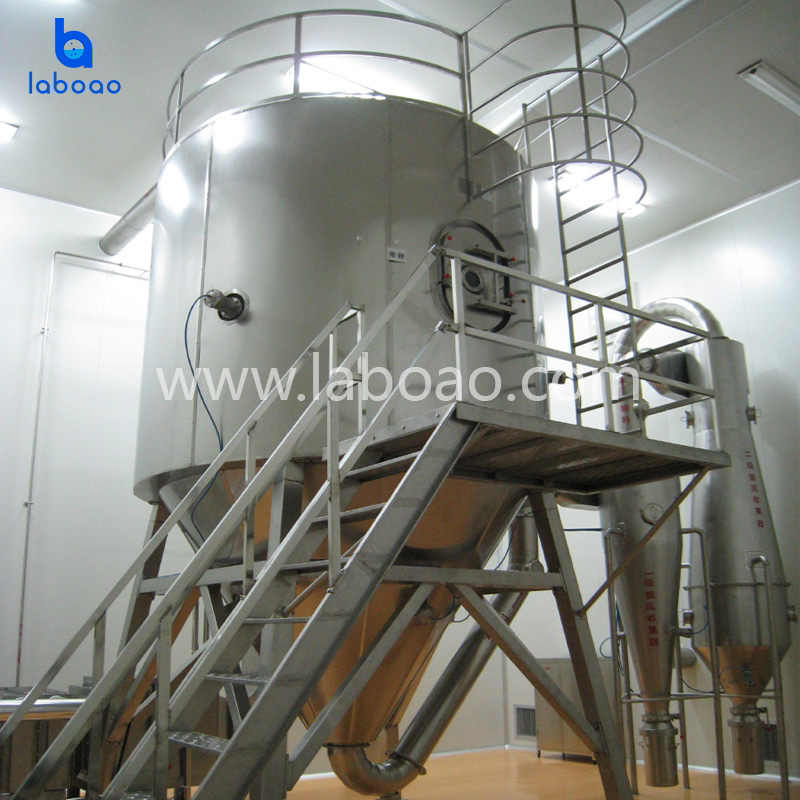
I. Principles of Spray Drying Technology
The basic principle of spray drying involves pumping the material through a filter to an atomizer located at the top of the spray dryer. The atomizer disperses the liquid material into fine droplets. Due to their small radii, high specific surface area, high surface free energy, and high degree of dispersion, the vapor pressure of moisture on the droplet surface exceeds that of a flat liquid surface under identical conditions; consequently, moisture evaporates extremely rapidly, resulting in quick product drying.
II. Key Factors Affecting Spray Drying
① Inlet and Outlet Temperatures
The temperature of the spray drying chamber usually refers to the temperature of the hot air entering the tower. Drying temperature is the most critical factor influencing the physicochemical properties of spray-dried powders. Higher drying temperatures supply more heat to the chamber, thereby increasing the drying rate and reducing the moisture content of the final product.
Increasing the spray drying temperature from 120°C to 200°C can reduce the moisture content of the dried powder from 5.29% to 3.88%. The particle size of the spray-dried product also depends on the dryer inlet temperature. Higher drying temperatures accelerate moisture evaporation, causing microspheres to form rapidly without sufficient time to shrink, which results in larger particle sizes.
As the inlet drying temperature increased from 138°C to 202°C, the particle size of açaí berry powder increased from 13.38 μm to 20.11 μm. Similarly, the particle size of guava juice powder increased significantly (p < 1%) with rising inlet temperatures. The bulk density of spray-dried powder decreases as the temperature rises. Larger particles may be hollow inside or possess porous or fractured structures due to rapid moisture evaporation; generally, porous or fragmented particles exhibit lower bulk density. Since water is denser than most dry food solids, powders produced at higher temperatures exhibit lower bulk densities than those produced at lower temperatures; additionally, it has been observed that smaller powder particles possess higher bulk densities.
The flowability of spray-dried powders is also influenced by drying temperature; flowability decreases as the temperature rises. Solubility is another critical quality characteristic of powder products, directly affecting the reconstitution behavior of spray-dried foods. Powder solubility increases as the spray-drying temperature rises from 120°C to 160°C.
② Wall Materials
Sugar-rich substances, such as fruit and vegetable juices, are difficult to spray-dry directly without encapsulating agents. Wall materials—polymers used to encapsulate active ingredients during the spray-drying process—are among the most important factors in spray drying.
Wall materials can increase the glass transition temperature and product yield while reducing the stickiness and hygroscopicity of the resulting powder. Common wall materials include gum arabic, maltodextrin, gelatin, starch, pectin, methylcellulose, alginates, tricalcium phosphate, and combinations thereof.
The choice of wall material depends primarily on the objective of the spray-drying process and the physicochemical properties of the material being processed. Wall materials should be highly soluble in the process solvent, possess adequate film-forming capabilities, and yield low-viscosity solutions even at high concentrations. For spray drying, they must have high molecular weights and high glass transition temperatures to improve the anti-sticking properties of the final product. They must also be capable of protecting sensitive compounds from heat, oxygen, and light.
Carbohydrates are the most commonly used wall materials for spray drying, including:
1) Starch and its derivatives (starch, maltodextrin, dextrin, and cyclodextrin);
2) Gums (gum arabic or mixtures of gum arabic and karaya gum);
3) Cellulose and its derivatives (cellulose, carboxymethylcellulose, hydroxypropyl methylcellulose, etc.).
Starch and its derivatives exhibit excellent spray-drying characteristics, such as high molecular weight and high glass transition temperature; they are highly soluble in cold water at low viscosities, possess anti-sticking properties, and are capable of producing relatively dense powders. However, their film-forming ability is relatively poor, which is disadvantageous for drying efficiency—particularly regarding the preservation of sensitive compounds.
Compared to starch, gums exhibit superior film-forming capabilities but have relatively low glass transition temperatures. Cellulose and its derivatives possess good film-forming properties and surface activity but are difficult to digest. Combinations of starch (or starch derivatives) and gums can improve spray-drying performance, though the gum content should remain lower than that of the starch component.
Proteins—especially whey protein—offer excellent film-forming and nutrient-retention capabilities and are frequently used in conjunction with starch or starch derivatives.
③ Feed rate
The feed rate is a critical factor in the spray-drying process. It determines the residence time of the material within the drying chamber, separator, and conveying system, while also influencing atomization and droplet size. The feed rate is largely determined by the atomizer speed; a higher pump speed results in a faster feed rate. However, an excessively high feed rate slows down heat transfer, making it difficult for droplets to dry thoroughly and increasing the likelihood of wall adhesion.
Furthermore, high feed rates can lead to incomplete atomization, causing droplets to fall directly onto the walls or floor of the drying chamber and reducing overall yield. High feed rates limit the interaction time between droplets and hot air, thereby increasing the moisture content of the spray-dried powder; additionally, the reduced contact time lowers heat and mass transfer efficiency, resulting in a higher final moisture content in the product. III. Common Issues and Improvements for Spray Drying Towers
Issue 1: Explosion Prevention Measures
1) Select the appropriate type of drying tower;
2) Install fire suppression equipment during the design and manufacturing stages;
3) Use smooth materials for equipment surfaces in contact with the material to prevent accumulation;
4) Install air filters to prevent dust-laden exhaust gas from being drawn into the air heater;
5) Regularly clean the air filters, including washing them;
6) Regularly inspect areas prone to material accumulation during operation;
7) Regularly inspect all electrical and mechanical components;
8) For centrifugal atomizers, ensure rotating parts operate smoothly and inspect them frequently;
9) Install static grounding devices;
10) Maintain thorough cleanliness of all dryer components.
Additionally, to minimize potential losses from material combustion or explosions within the tower, measures such as installing explosion relief valves at the top of the drying chamber, fitting automatic pressure-release flaps on the chamber walls, or designing thicker chamber walls to withstand potential explosions can be implemented.
Issue 2: Wet powder adhering to the inner wall of the main tower
1) Feed rate is too high, preventing sufficient evaporation;
2) Insufficient pre-heating of the drying chamber before spraying begins;
3) Feed flow rate set too high at the start of spraying;
4) Unstable feed liquid supply.
Remedies:
Appropriately reduce the feed rate; raise the hot air inlet and outlet temperatures; start with a low flow rate and gradually increase it to the optimal level; check for pipeline blockages and adjust the solids content of the material to ensure proper flowability.
Issue 3: Excessive powder loss and low product recovery rate
Powder loss often occurs due to issues with the cyclone separator or poor dust collection performance. Solutions include: for cyclone separator issues, inspect the unit for gaps or leaks and verify its airtightness; for poor dust collection, consider adding a secondary dust collection stage.